 Kriti
Kriti
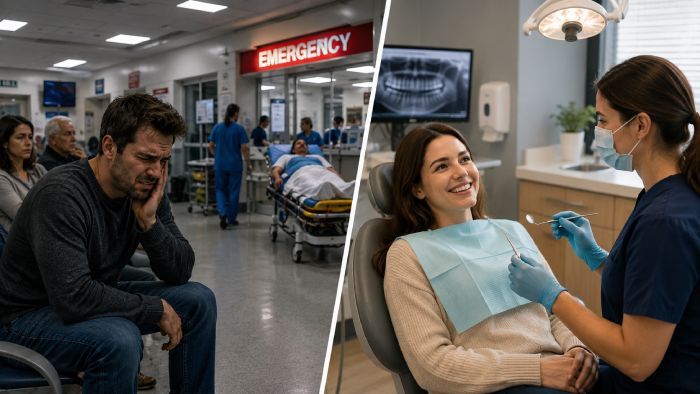
Toothaches can make everything unbearable. Especially when it hurts you at 2 am. However, not all dental emergencies warrant a trip to the ER. The type of care you need will depend on the situation and not necessarily the level of pain. To help you make the best decision, here’s a guide on when to seek emergency dental care versus emergency medical care.
What an ER can and can’t do for your teeth
Hospital emergency rooms are not designed for treating dental problems. Rather, they are meant to stabilize patients with acute medical conditions. If you have an infected tooth, your emergency room doctor can’t treat the infection but may give you medication and advice to stabilize you for the time being. They might also tell you that the infection has not reached your bone or airway, which is obviously important information. But they can’t pull a tooth.
If you have a toothache, it may be because you have a cracked tooth. A cracked tooth cannot repair itself and will get continuously worse until you see a dentist about it. If you have an abscess, that’s a potentially lethal infection that needs to be drained. Antibiotics can treat a bacterial infection for a while, but the infection will return and, more importantly, the source of the abscess will remain.
Now, here’s the kicker: in the isolated instance where you really could have used an ER, you’d still have ended up seeing a dentist. If you lose a tooth, you must get it back into its socket in the next half-hour. This is genuinely an emergency, and an emergency department can’t save the tooth. They might give you a tip on how you can store it best while driving but ultimately you need a dentist to splint it.
Knocked-out and loosened teeth: minutes matter
If a tooth is dangling, a dentist can stabilise it with a splint. While a very loose tooth may heal on its own, a tooth should never just be left to re-embed itself, because it will almost certainly heal improperly or become infected. Knocked-out or loosened teeth may also be putting remnants of the periodontal ligament into the socket, shards of bone or enamel into the gums, and/or nerve endings or blood vessels into the open air.
Such wounds should be professionally irrigated, cleaned, autoclaved, sometimes grafted, and splinted where necessary to prevent the loss of bone, to prevent serious infection, and to adjust for bite alignment among other structural considerations. An Emergency Dentist Welshpool (or similar in your area) will also put you on antibiotics if needed.
This is not to say that a hospital won’t provide the skull and/or jaw x-rays necessary to look for alveolar bone fractures, subluxations, or jaw dislocations and fractures: they will, and if you have those injuries you also have a medical emergency calling for the ER’s musculoskeletal specialization. However, even if there is also a maxillofacial trauma in play, the actual dentition and tooth rescue are handled by a dentist on an emergency basis.
The abscess decision rule
Dental abscesses cause a lot of unnecessary visits to the ER, especially for relatively minor cases. A localised abscess – swelling confined to the gum near one tooth, tenderness, maybe a visible pimple-like bump – is something a dentist can drain and treat directly, often the same day.
The line you need to watch is spread. If swelling is moving toward your eye, down your neck, or into the floor of your mouth, that’s different. If you’re having trouble swallowing, opening your mouth fully, or breathing normally, that’s a sign the infection may be tracking into deeper tissue spaces. Conditions like facial cellulitis or Ludwig’s angina start this way, and they can progress to airway obstruction. That’s a genuine emergency and it belongs in an ER, no debate.
The simple version: pain and localised swelling, call a dentist. Spreading swelling, fever with facial involvement, or breathing and swallowing trouble, go to the ER.
What it actually costs to choose wrong
For most ER visits for a dental problem, there’s a general facility fee just to walk in the door. Then there’s a separate fee for the dental checkup before you even get any imaging or prescriptions. Medical coverage may or may not cover a big chunk of it. Dental problems tend to fall into a gray area between medical and dental benefits. Dental benefits pretty much never cover ER visits.
Meanwhile, at a dentist’s office, that same problem is diagnosed and frequently resolved in one visit. At a cost that is often a fraction of the ER invoice. According to the AHRQ, approximately two million Americans go to the ER each year for dental problems. Two-thirds of those ER visits are for things that can and should be addressed in an oral health care setting. This is not an isolated incident. This is a regular routine of people paying more than they should, waiting for hours instead of minutes, and not even having the work done to fix their problem.
Same-day dental care versus the ER waiting room
Triage protocols in hospital emergency departments exist for good reason. The person having a heart attack gets seen before the person with a toothache, every time. That means dental complaints, which are rarely immediately life-threatening, sit near the bottom of the priority list. Waits of four hours or more for a dental issue in an ER are routine. At the end of it, you will likely walk out with medication and a referral rather than a solved problem.
Genuine emergency dentists work differently. Most keep same-day slots specifically for walk-ins and urgent cases. Many offer after-hours availability for exactly this kind of situation. If you are dealing with a swollen face, a broken tooth, or pain that’s kept you up all night, and none of the red-flag symptoms above are present. Your fastest path to actual relief is usually a phone call to a local clinic, not a drive to the hospital. A good emergency dental practice can usually get you seen the same day and provide treatment on the spot .Rather than sending you home with a prescription and a promise to follow up later.
Why imaging matters more than people think
One important limitation of ERs is the lack of diagnostic imaging for dental issues. Some hospitals can provide a panorex scan, which offers a wide view of the jaw. It is not detailed enough to identify a root fracture, determine the precise location of an abscess, or evaluate an impacted wisdom tooth. For these cases, dentists use periapical X-rays, which provide a significantly higher level of detail at the root and bone level.
This gap in imaging can result in serious issues. A patient receives a panorex in the ER; nothing is immediately evident. They go home with painkillers despite having a hairline root fracture or a deep abscess that would have been visible on a periapical film. The pain returns, sometimes stronger, and they’re back at square one with the original issue and tolerance to the medication.
If you have had a dental X-ray in an ER. You are still in pain a day or two later, that’s a sign to get to a dentist for proper imaging rather than assuming the ER cleared you of anything serious.
First aid while you wait for treatment
There are some things that are a good idea to do no matter whether it is a dentist or an emergency department you are ultimately heading to.
For instance, icing a swollen face or lip in short bursts (15-20 minutes at a time with an hour’s break in between each one) can help keep the inflammation down from just about anything, from a bee sting to a wisdom tooth.
Similarly, even if you can get to a dentist in the next half hour, sticking a tooth back in milk or saline can save it. If it came out after a blow to the face (just make sure not to touch the root), making a very loose tooth splinted to the one next to it with a piece of wax (pliable wax from a candle, not sticky wax from Sculpey) might just let you keep it.
Putting aspirin on the exposed pulp or the inside of a chipped tooth is a bad idea. It will just burn the living heck out of your mouth. Nor will a popped-out crown benefit from the application of dry ice. Putting a dry tooth in the socket of a knocked-out tooth won’t work, so don’t do it.
Again, the goal with all this is just to keep things from getting any worse until you can get proper treatment.
Red flags that override everything else
No matter your dental coverage, cost, or proximity to your dentist’s office, some symptoms warrant a trip to the ER with no delay: Uncontrolled bleeding that doesn’t cease with pressure. Trauma to the face and possibly the jaw, such as a fall or a blow to the face, or loss of consciousness. Any breathing or swallowing problem. Swelling that’s spreading quickly toward your eye, or your neck or throat. A severely compromised immune system and evidence of a spreading infection, because what might be a manageable abscess in a healthy immune system can deteriorate quickly in someone who’s immunocompromised.
Those aren’t guidelines. If you have any of the above, the ER is the right call, end of story, and dental has to stay put until you’re stable.
What to look for in a true emergency dentist
Not every practice that says “emergency” actually delivers on it. Look for same-day appointment availability, not just a promise to “fit you in when possible.” Look for after-hours contact options, since dental crises don’t wait for business hours. And look for a practice that can actually perform restorative work in the visit – extractions, temporary fillings, drainage, splinting – rather than one that mostly hands out pain relief and reschedules you for later. A clinic that can do the definitive work in one sitting is the whole point of calling a dentist instead of sitting in a waiting room.
The choice between ER and dentist isn’t about which one feels more serious. It is about which one can actually treat what’s wrong with your tooth. Know the red flags, keep a dentist’s number saved for when the pain hits. You will spend a lot less time waiting and a lot less money getting nowhere.