 Jane Hill
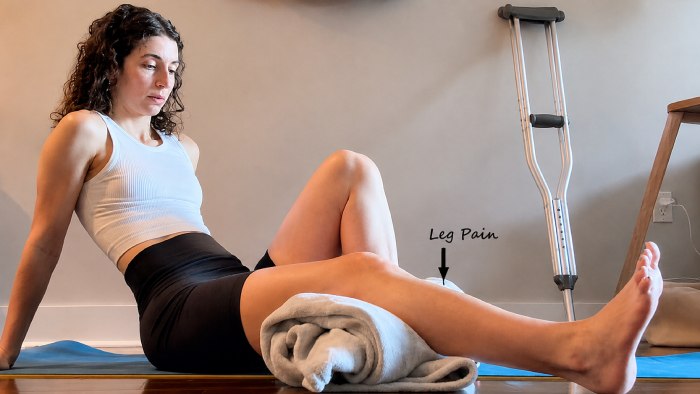
One of the most misunderstood complaints in musculoskeletal care is radiating leg pain. The pain is in your leg, but the problem almost certainly isn’t. Understanding that gap is the first step toward actually fixing it.
Why Your Leg is Lying to You
The nervous system doesn’t feel pain where the injury occurs. Rather, the pain signal is transmitted through the nerve path, and you perceive the pain wherever the nerve ending goes. When a nerve root in your lower back becomes compressed or irritated, your brain senses that something is wrong in the leg, foot, or buttock that the nerve serves. This is known as referred pain, and it explains why massaging your calf or stretching your hamstring might alleviate the symptoms temporarily, though it does not address the cause of the pain.
The sciatic nerve is the longest in the human body. It emerges from multiple nerve roots in the lumbar spine, specifically, L4 through S1, and travels through the buttock, down the back of the thigh, past the knee, and into the foot. If anything is pressing on one or more of those roots, you may feel pain or other symptoms anywhere along the length of the nerve. Where you feel symptoms gives us a clue as to the cause of the pain, rather than acting as the pain generator in itself.
Correcting the Mechanical Cause, Not Just the Symptom
Because most radiating leg pain is caused by physical pressure on a nerve from misaligned or degenerated spinal structures, the simplest way to solve the problem is mechanical correction. Fixing the structural issue decompresses the nerve, eliminates the signal causing the pain, and allows the body to reset.
That’s where sciatica pain chiropractic care comes into play. Targeted spinal adjustments are used to restore appropriate alignment, decrease mechanical pressure on the impacted nerve root, and give the body the best possible opportunity to recover naturally, without the need for surgical intervention. Up to 40% of people will experience sciatic nerve pain at some point in their lives (Harvard Health Publishing), and, for most of those people, the issue is mechanical in nature, and the solution is not found in an OR.
Chiropractic care, or physical therapy, or both, depending on the specifics of your situation, is where the current guidelines lead most people first. Surgery becomes necessary in extreme cases of nerve damage or structural instability, but restoring proper biomechanics does the trick for the vast majority of patients.
True Sciatica vs. What Looks Like it
Leg pain can radiate in different ways, and the type of pain can influence the treatment you get.
Sciatica is radiculopathy, which results from your nerve roots being compressed in your spine, typically by a herniated disc, bone spur, or spinal stenosis. The disc protrudes into the area where the nerve exits the spine, the nerve is pinched, and the signal goes down your leg: you feel that as pain, numbness, or tingling.
Piriformis syndrome could not be more different. The piriformis is a small, thick muscle deep in the buttocks that the sciatic nerve happens to run directly under or through. If the muscle tightens or spasms, which can happen from sitting too long, overtightening in training, or compensating for an unstable or dysfunctional hip, it can compress the sciatic nerve directly, but it is not doing so at the spine; it’s pinching it directly against the muscle.
There’s no loss in spinal range of motion in piriformis syndrome, though, and the spine can usually be moved freely without symptoms. Only the hip movement sends the familiar pain down the back of the leg.
Unlike a spinal cause, piriformis syndrome doesn’t cause reflex loss, muscle weakness, or changes in the way the muscles respond to stimulation; you won’t alter your gait because of it.
Reading Dermatomes to Trace Pain Back to Its Source
Medical professionals use a concept called dermatomes to map pain from your skin back to the likely spinal level causing a problem. A dermatome is the area of skin supplied by a specific nerve root. Since each lumbar level serves a slightly different part of the leg, a precise look at whether and where your pain travels can help your clinician identify which nerve root may be impacted.
Pain and numbness that travel down the outer shin to the top of the foot and big toe often map back to L5. Symptoms that go down the back of the thigh and calf to the outer heel and little toe are more likely associated with S1. And L4 tends to cause pain on the inner shin with quad weakness.
This isn’t a diagnosis by itself, but it’s a useful step to get started. The more specific your clinician can be in asking exactly where the pain goes, not down the leg, but about how far, and then in the foot, where? – the more likely it is that they’re using this map to guide them.
Physical Tests That Confirm Mechanical Compression
The Straight Leg Raise test is a very valuable tool in any clinician’s wheelhouse. To perform it, the patient lies flat on their back while the examiner slowly lifts the leg, with the knee straight. This movement puts mechanical tension on the sciatic nerve as well as the L4-S1 nerve roots.
If this low-tech test reproduces radiating pain below the knee at a relatively low angle (somewhere underneath 70 degrees), the likely culprit is a herniated disc that’s compressing the nerve root. Combined with dermatome mapping and a thorough history, it gives a clinician most of what they need to identify the level of compression without immediately reaching for imaging.
Putting it Together
Most people mistake the source of radiating leg pain. Although the pain is felt in the leg, the nerve is compressed somewhere in the lower back, and the route the pain travels is the map. Dermatomes, orthopedic testing, and a clear divide between spinal and muscular causes allow clinicians to determine the road. Treat the source, and the leg pain disappears.