 Jane Hill
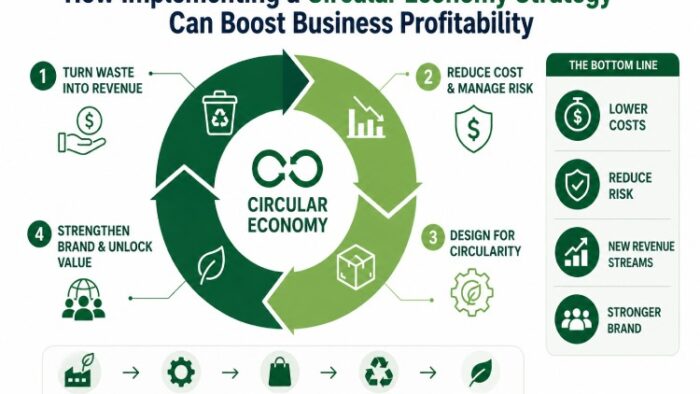
The circular economy is not necessarily a benevolent environmental trend. It is one of the most sensible strategic moves available to companies that are serious about protecting their margins and supplies in an increasingly volatile world. Looking at waste as a design flaw, rather than an operational necessity, changes your attitude to costs, risk, and your position compared with competitors.
Turning Scrap Into a Secondary Revenue Stream
Most producers view production scrap as waste that needs to be disposed of. A circular approach regards it as an untapped resource.
Manufacturing offcuts, rejected product, and production scrap could instead be collected and sold on as a raw material, or reprocessed in-house and used again as feedstock. The waste disposal line on a P&L sheet becomes either neutral or, with the right relationships in place, even a small revenue stream.
This isn’t pie in the sky. Some companies producing industrial plastics run closed-loop systems and have cut their net material costs by no longer sending anything to the dump, but instead reselling or reprocessing it. Due to how this model works, it does mean sinking some CapEx into some new sorting and handling kit, but the long-term mathematics almost always stack up.
Perhaps less obviously, an increasing number of these producers are even finding they need to procure their feedstock, their own scrap, back once it’s left the factory gate. Such is the boom in virgin pricing, the growing awareness of pollution costs, and the tightening supply chain for fossil fuels needed to produce it.
Advances in how materials are sorted and processed also mean there are a lot more avenues you can go down here than you might think. For companies looking to integrate quality-verified recycled materials into their supply chains, working with specialists like IPL Brightgreen matters. Optical and chemical analysis tech can now sort and separate polymer types with growing precision, leading to the possibility of recycling old plastics for high-grade industrial applications.
Why the Linear Model is Becoming Expensive
The classic linear model involves taking, making, and disposing of products. However, the costs associated with this model are becoming increasingly apparent. Your use of virgin plastics means that your product costs are directly linked to the volatile crude oil market. In cases of extreme fluctuations in oil prices, the costs of your supplies increase, without much that can be done to mitigate the issue if your supply chain operates in one direction only.
The problem is being exacerbated by regulatory demands. Taxes on plastic packaging and extended producer responsibility systems related to packaging waste are in effect or in the process of being implemented in many major economies. Companies that still use the linear manufacturing model are in a vulnerable position; they are obligated to pay taxes for materials in their virgin state, while their competitors that use post-consumer resin are subject to lower taxes and have more stable costs.
Apart from lowering your environmental impact, replacing virgin polymers with recycled ones allows you to eliminate a considerable source of cost-related volatility in your COGS.
In reality, the resilience of your supply chain often depends on the availability of different types of inputs. Circular sourcing can ensure that.
Design is Where the Money is Made or Lost
Product design is one of the most underappreciated elements of a circular economy strategy. Design a product so that its components can be easily separated and recovered, or even re-used, and you simplify the recycling process. With less manual labor required, you reduce costs and the risk of contamination, which means you can recycle more and at a higher quality. More robust recycling markets attract more investment, driving innovation and the development of ever more efficient recycling technologies.
Circularity as Brand Infrastructure
Buyers who care about environmental performance aren’t just a niche segment anymore, and companies with transparent, auditable claims on recycled content tend to hold pricing power more effectively than those competing purely on cost. Life cycle assessment methodology is becoming the standard by which those claims are verified. Companies that have run credible LCAs on their products have a defensible story to tell investors, procurement teams, and end consumers. Those that haven’t are increasingly on the back foot.
The Ellen MacArthur Foundation estimates that the circular economy transition could unlock $4.5 trillion in economic opportunity by 2030 through waste reduction and business innovation. That figure reflects what’s available across industries collectively, but the companies positioned to capture their share will be those that moved early, not those that waited for regulation to force the issue.
Where Strategy Meets Action
There is nothing inherently altruistic about resource decoupling. The companies that have been successful in their efforts to increase output without a corresponding increase in virgin material use have integrated principles of the circular economy into their business model because the business case either stands on its own or because regulatory and customer expectations justify moving in that direction. Wringing more value out of existing assets, labor, and materials doesn’t appear to have much in the way of a downside. But apparently not a large enough upside for a lot of businesses to act.