
 Jeremy Bowen
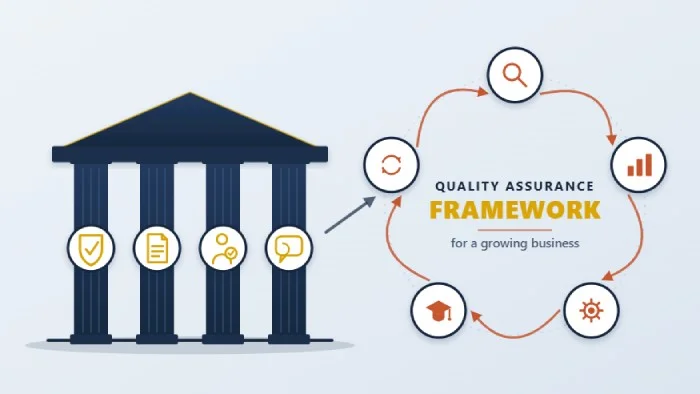
Many expanding businesses face the same challenge. When everything moves at a breakneck pace, with a new hire starting every other week and ten new customers coming on for every one that churns. The only thing that scales is your faith that ‘things will probably be OK if I stay at the office until 8 pm today.’ That faith won’t last. Quality in this context is a stand-in for ‘I trust that we aren’t accidentally growing an unsustainable business.’
Define Quality Before You Build Anything
If you skip this step, you will be left with a giant binder full of procedures that nobody actually follows because nobody ever agreed on what those procedures were there for. In order to put anything in place, that thing has to be specific and measurable. This is what we call “defining measurable outcomes”. A quality culture for a playgroup that meets on Saturdays would not involve the same performance metrics as a CERN research team. It is the same with an email campaign and an airplane engine.
In business, quality outcomes will differ depending on your business model, but generally. We are talking about “defect rate”, “complaint volume”, “delivery accuracy” or “first-pass yield on manufactured units”. Once you know what you’re measuring, you can decide on the important numbers. Pick numbers that matter to you, that are attached to costs or decisions that you make, not some borrowed generic from an industry report.
Separate Quality Assurance From Quality Control
Most companies that are on their way up default to quality control; those few processes or people that are supposed to inspect what comes out of the other end of what your organization does. It is having someone double-check the report before you send it to the client. It is looking for the tenth time at the product before you ship it. It is the robot on the assembly line that throws the bad unit into the reject bin before it goes in the box and gets shipped. QC is reactive. QC is about finding and catching what’s already broken. It is a gate, but it’s not a wall. It is not even a particularly effective gate because inevitably some errors get through with the good units. But it’s necessary.
Quality assurance is different. It is the set of process controls that reduce the odds of defects happening in the first place: clear specs, trained staff, defined handoff points, documented procedures. A business that only invests in QC is paying people to find fires. A business that invests in QA is reducing how often fires start. You need both, but if your quality spend is 90% inspection and 10% process design, you are managing symptoms and calling it strategy.
Start With Your Riskiest Workflows, Not All of Them
Avoid trying to capture everything at the same time. This kills quality assurance (QA) work because after a month, it is clear it’s going to take at least five months to write everything down well enough that a junior hire could follow the directions and create the perfect assembly every time, and that solid week you spent auditing and adjusting the process left it no clearer than when you started. So, everyone shrugs, says the quality work was an interesting let’s-all-laugh-and-never-speak-of-it-again experiment, and goes back to assembling widgets. Pick a couple of key processes instead. The tier one processes are the very few things where you can’t afford to not notice an error before it gets too late, or to allow variations in performance to accumulate to the point that their cumulative effects are failing to meet the customer’s expectations. So for a factory, maybe the tier one process is the couple of production line steps that are most likely to generate component rejection if not done correctly.
This is also the point where you move from informal habits to something written down. Instead of leaving your quality checks as tribal knowledge that lives in one manager’s head, you codify your standard operating procedures, checkpoints, and review steps into formal quality management plans that any new hire can pick up and follow without needing someone to explain it verbally first. That’s the difference between a process that survives someone quitting and one that doesn’t.
Build the Framework Around a Loop, Not a Document
A quality framework that is, in essence, a PDF no one reads after the rollout meeting is never going to be effective; it is a document repository. Instead, base it on Plan-Do-Check-Act, the improvement loop that’s made quality processes work for decades:
Plan – set the quality objective and the standard you are aiming at. Do – do the work in the way you’ve defined from the plan. Check – measure the outcome against your criteria. Act – Take action to fix any deficiencies, update the procedure with the new corrections, and feed the solutions back into the plan.
This is the heartbeat of how the system works. If you don’t use this loop, you write down what you think the process is and slowly let it become obsolete over time as your business changes. If you use it, every time you execute the loop, the process gets one iteration easier, because the check results are applied before the problems show up.
Put Quality Gates Where Defects Would Otherwise Travel Downstream
A quality gate is like a checkpoint that prevents work from advancing if it does not satisfy a particular requirement. It could be a product release, a major delivery to a client, a code merge, or a final inventory check before shipping a product; those times when a gate is introduced.
The reasoning behind a gate is fairly simple: it is far less expensive to identify a mistake at the gate than after the customer has found it for you. End-of-line inspection will also identify defects, but by this time, you have used the labor, the raw materials, and the capacity to build something that you now need to rework or throw away. Gates located earlier in the process will prevent this loss before it can escalate. They will also provide you with data: if a particular gate keeps failing work, you know exactly where your process is failing, which is a lot more helpful than noticing that ‘quality has been slipping’ lately.
Assign Ownership so Quality Doesn’t Default to “Whoever Notices First”
Once the founder is no longer the one doing, building, shipping, writing, and checking everything. It has to be owned by somebody, or it will slip between the cracks of departmental ownership. A RACI matrix- responsible, accountable, consulted, informed- is a nice, simple way to do this because it sounds more complicated than it is.
But for every activity related to quality, you nominate a name and put them in the ‘A’ column. Not ‘the team.’ Not ‘whoever has time.’ A person.
This becomes more essential as you add departments and therefore silos. Quality assurance is the piece between production, engineering, customer support, and leadership that everyone assumes someone else is doing. It does not just magically kind of happen. The RACI matrix forces those cross-functional handoffs and the explicitness of where the buck stops.
Track a Small Number of Metrics, and Actually Review Them
You don’t need forty quality metrics. You need five or six that tell you whether the system is working, tracked consistently enough to spot trends. Good starting points:
- Defect escape rate – how many issues make it past internal checks to the customer
- First-pass yield – the percentage of work that meets standard without rework
- Customer-reported issues per period
- Time to resolve a quality complaint
- Rate of repeat defects on the same root cause
Review these on a set cadence; monthly is typical for most growing businesses, and use them to justify continued investment in QA. This is also the point where you can show skeptical leadership that quality isn’t a cost center. If first-pass yield climbs and complaint volume drops, that’s revenue protected, not spent.
Fix the Process, Not the Person
When a defect reappears, our natural reaction is to identify the person who erred. But that’s rarely the right answer. Root cause analysis is meant to uncover the real culprit beyond the superficial one (“somebody missed a step”) and highlight the underlying issue (“nobody monitors whether the step is missed until it’s too late to correct it”).
After identifying the root cause, corrective and preventive action (CAPA) is where you permanently close the loop: solve the immediate problem, and then modify the process so this kind of problem won’t come up again. Forgo CAPA, and you’ll have the “somebody missed a step” discussion each quarter, with a different name scribbled in for the mistake-maker. Quality systems that are engineered around blame foster cover-your-ass, low-level duplicity. Systems that are process-oriented foster early-warning, open disclosures, and that’s exactly what you want.
Automate Only After the Process is Stable
Automated testing and QA tooling are great, but only after you have more to test than you possibly can manually. The error is applying automation before you even know how the process works, much less have a defined process.
Automating something that is not even consistent just makes the mistakes come faster and with more certainty that they are mistakes.
The sequence is: 1. Write down how you think the process works. 2. Run the process a few times, check the results against your notes, and update the notes to match your actual process. Repeat the PDCA cycle a few times until the results stabilize. 3. Now that you have a consistent process, look for repetitive parts of it that you can automate. Lead with building a process you trust, then extend it with tooling.
Make Quality Everyone’s Job, Not One Department’s Mandate
The final element is cultural, and it is the one that most frameworks leave out. When quality is entirely the responsibility of a manager of quality or a team of quality assurance (QA) folks, everyone else in the company expects that it’s someone else’s job to catch all the mistakes. Instead, incorporate it into the job descriptions and yearly reviews of every department, production, sales, support, engineering, whatever, so that every person is implicitly measured against the quality of the work they enable, rather than the whole of that work being seen as a separate checklist that some other group is responsible for.
This is also what transforms “continuous improvement” from an empty slogan into something that people do. Kaizen-style thinking, small, incremental, ongoing changes to a process that are surfaced by the people working within it, only works if the people closest to the process in question feel some level of ownership over the quality of the changes, and not just of the list of changes the department with Quality in its title is making.
So you can build a quality assurance (QA) framework in a growing business, but you need to define clear quality standards, assign dedicated ownership, implement continuous testing and monitoring processes. You can also use feedback loops to drive ongoing improvements across all products and operations.