 Kirsty Wark
If you are designing big enclosures, housings, or structural panels and your default choice is still sheet metal or fiberglass. You are likely missing out on some serious cost savings. Heavy-gauge thermoforming has reached a point where it is not only cost-competitive vs traditional manufacturing. In many cases, it is a better choice based on cost, weight, and lead times combined.
The Tooling Cost Argument is Hard to Ignore
The comparison begins with tooling. Injection molding needs precision-machined, double-sided steel molds that can cost from tens of thousands to hundreds of thousands of dollars even before a single part is produced. Heavy-gauge thermoforming uses single-sided molds. Typically aluminum or wood composite, which costs a fraction of that. Tooling costs for heavy-gauge thermoforming usually are 80% to 90% less than an injection molding tool of equal size and complexity (Society of Plastics Engineers Thermoforming Division).
For OEMs producing between 250 and 5,000 units per year, that cost difference seldom disappears. Injection molding’s per-unit economics only pencil out at extremely high quantities, quantities most industrial and specialty equipment manufacturers don’t achieve. If your annual run is a few hundred units of a large cab panel or equipment shroud. Thermoforming is the winner before we even have the engineering discussion.
Speed From CAD to Production
One of the advantages that does not get enough press is how fast thermoforming tooling can be produced. Because the molds are less complex, an OEM can go from a final CAD design to a physical prototype in a matter of weeks. It can take months to produce an injection mold for a comparable part.
If you are a product team with a ticking clock to hit a launch window, or racing to get a product to market or respond to a late-stage design change, that lead time can be the difference between success and failure. Vacuum forming and pressure forming molds can also be more easily modified post-production, which means far lower costs for design iteration. You are not tossing a $150,000 steel tool because a customer decided to move a mounting bracket.
To get material selection right and design the best part for draft angles and wall thickness uniformity. The advice for an OEM is to engage a qualified custom manufacturer like New Plastics Plus early in the process, before designs become locked and compromises start to get built into the project.
Material Performance is no Longer a Compromise
The older knock on thermoformed plastic was durability. That criticism doesn’t hold up against modern thermoplastics. ABS offers impact resistance and dimensional stability across a wide temperature range. HDPE handles chemical exposure and rugged outdoor conditions without degrading. TPO combines weatherability with flexibility, which is why it’s now standard in agricultural and automotive shrouds.
These materials replaced fiberglass in a lot of applications over the past decade, and the reasons are straightforward. Fiberglass is labor-intensive to produce, inconsistent between runs, and harder to recycle. A thermoformed HDPE panel is dimensionally repeatable, lighter, and does not require gel-coating or secondary finishing to achieve a clean appearance. It also will not delaminate or absorb moisture the way FRP components can in prolonged outdoor exposure.
Sheet metal comparisons follow a similar logic. Thermoformed parts weigh significantly less than steel equivalents of the same geometry. In transit, agricultural, and construction equipment, that weight reduction adds up across an entire assembly. It reduces fuel consumption and makes installation faster.
Pressure Forming Closes the Gap on Aesthetics
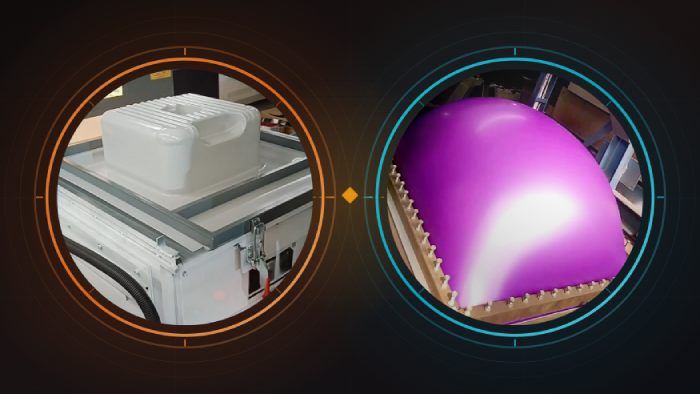
Some engineers view thermoforming as unable to produce the surface detail and tight tolerances inherent to injection molding. Pressure forming simplifies the math. By adding positive air pressure to the process and pushing the heated plastic against the mold surface. Pressure forming enables the molding of sharp edges, textured finishes, and geometric details that vacuum forming alone cannot achieve simultaneously.
Incorporating pre-colored raw material, thermoformed parts exit the process ready to ship. Eliminated are expenses related to painting, gel-coating, or other potentially labor-intensive secondary finishing processes. With enclosures and housings, where perceived value can be directly attributed to the aesthetics of the product. This potentially does away with an entire underestimated line item in the project budget. Post-forming, a trimming/finishing sequence using CNC routers, cuts holes, slots, and edges to within 1/1000th of an inch to bring parts to spec. Paired with pressure forming, robotic finishing produces parts at tolerances well within what injection and tooling can achieve.
Design Considerations That Matter Early
To get the most out of heavy-gauge thermoforming, start thinking about a few constraints during the design phase. Draft angles, the taper on the vertical walls of a mold, must be included in your design to ensure the part can release cleanly as it cools. Wall thickness uniformity must be factored into your design on deep-draw geometries, as the plastic will stretch and thin itself out across the mold surface. None of these issues are showstoppers, but they do require some engineering before the fabrication shop can start cutting aluminum.
Teams that treat thermoforming as a drop-in replacement for metal or fiberglass without adjusting their design approach tend to see avoidable problems. Teams that design for the process from the start consistently get better outcomes.
The economics favor thermoforming at low-to-medium volumes. The materials perform in demanding environments. The lead times are shorter. For most large-part applications in the 250 to 5,000 unit range, the question isn’t whether thermoforming can do the job; it is whether your design is set up to take full advantage of it.